Qawwali Night - Lyrics & Translation
01. MAN KUNTO MAULA
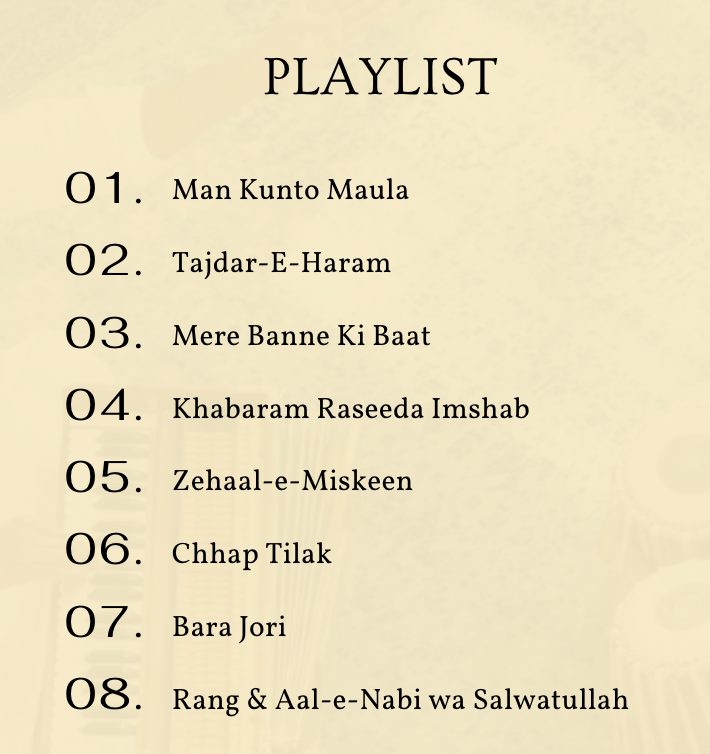
Man Kunto Maula is one of the most sacred compositions in the qawwali tradition - a saying (qaul) of the Prophet Muhammad:
“Whomsoever I am master to, Ali is also his master.”
In qawwali, the qaul is the foundational form: a musical rendering of divine speech, traditionally performed first to invoke spiritual authority. Set to melody by Amir Khusrau, Man Kunto Maula honors Imam Ali, regarded by Sufis as the gateway to inner knowledge. Its hypnotic repetition and rising intensity transform a hadith into a living, sonic prayer.
02. TAJDAR-E-HARAM
In this naat, praise of the Prophet Muhammad is invoked through an honorific name - Tajdar-e-Haram, King of the Holy Sanctuary. The lyrics are rich with metaphor, conveying majesty and emotional gravity, and emphasizing mercy and dignity. The repeated invocations move beyond performance and elevate the experience into shared supplication for hope that a single glance of compassion will transform hardship into ease.
Tajdar-e-Haram, Nigaah-i-Karam
Ham ghareebon ke din bhi sanwar jaaen ge
King of the holy sanctuary, bless us with your merciful gaze
So that our days of woe may turn for the better.
03. MERE BANNE KI BAAT
This piece is another naat sharif that uses gentle metaphor to express reverence and devotion to the Prophet and affirms his virtues of nobility and vast compassion (invoked here through reference to a groom).
04. KHABARAM RASEEDA IMSHAB
An exemplar of the purist Qawwali tradition, this composition - rooted in the poetry of Amir Khusrau - is rendered in a rare and esoteric raag preserved within the Qawwal Bacha Gharana.
More than a musical performance, it functions as a spiritual invocation, intended to guide both performer and listener toward a state of transcendence.
Employing microtonal ornamentation and a deliberately restrained melodic structure, the Saami Brothers evoke an intense emotional landscape of longing, love, and surrender.
At its core, the performance gestures toward the Sufi ideal of fanā - the annihilation of the self in the Divine - where the boundaries between singer, song, and the sacred begin to dissolve.
Kẖabaram rasīda imshab keh negār khwāhi āmad
Dil-e kharāb besūzī o bar-e qarār khwāhi āmad
Tonight I’ve heard you’ll come, my love -
To burn this ruined heart and then bring peace.
05. ZEHAAL-E-MISKEEN
This unique composition by Hazrat Amir Khusrau weaves together the languages of Persian and early Hindavi, shaping a shared expression for the universal experiences of yearning and longing. The poetry unfolds through layers of lament, confession, and offering. The many variations in performances of Zihaal-e-Miskeen reflect not only its enduring reach, but also the traditions through which it has been carried.
Zehaal-e-miskeen makun taghaful,
Duraye naina banaye batiyan.
Ke taab-e-hijran nadaram ay jaan,
Na leho kahe lagaye chatiyan.
Do not neglect this hapless one!
By blandishing your eyes and weaving tales,
My patience has over-brimmed, O sweetheart!
Why do you not draw me in close.
06. CHHAP TILAK
Amir Khusrau’s renowned composition articulates Sufi themes of fanā, self-annihilation and surrender. In contrast to worldly ambition, the act of submitting oneself to a power beyond full understanding is presented as a path toward freedom and renewal.
Chhap tilak sab cheeni ray
mosay naina milakay.
You have snatched away every trace of me
with one glance on your enchanting eyes.
This devotion has been interpreted through the lens of Ishq-e-Majazi, human love - often read as the bond between teacher and disciple, particularly Khusrau and Nizamuddin Auliya - as well as Ishq-e-Haqiqi, the total surrender to divine love.
07. BARA JORI
Though not part of the classical Sufi qawwali tradition, this piece comes from the thumri traditions of the subcontinent, composed by Wajid Ali Shah from UP, India. Sung in Birj Bhasha, it expresses a lover’s gentle protest to Kanhai (Krishna), reminding us that love cannot be forced.
While rooted in Bhakti poetry, such pieces are performed by the Saami Brothers, whose work bridges devotional worlds. In their hands, it becomes a shared expression of longing and the sacred ethics of love.
08. RUNG & AAL-E-NABI WA SALWATULLAH
Rung
The word "Rung" itself translates to color or hue, often symbolizing
the emotional and spiritual shades one experiences in the pursuit of
divine love and ecstasy. Amir Khusro wrote this poetry upon returning to his mother after meeting the Great Sufi Saint, Nizamuddin Auliya.
Aaj rung hai hey maan rung hai ri
Moray mehboob kay ghar rang hai ri
Sajan milaavra, sajan milaavra,
Sajan milaavra moray aangan ko
Aaj rung hai........
Mohay pir paayo Nijamudin aulia
Nijamudin aulia mohay pir payoo
Des bades mein dhoondh phiree hoon
Toraa rung man bhayo ri......,
What a glow everywhere I see, Oh mother, what a glow;
I’ve found the beloved, yes I found him,
In my courtyard;
I have found my pir Nizamuddin Aulia.
I roamed around the entire world,
looking for an ideal beloved;
And finally this face has enchanted my heart.
Aal-e-Nabi wa Salwatullah
This qawwali is a traditional salaam - a devotional salutation to the Prophet Muhammad and his family (Ahl al-Bayt), particularly his daughter, Syeda Fatima. Attributed to Amir Khusrau, the composition reflects profound reverence and spiritual love.
The recitation of blessings (salawat) in qawwali is both lyrical and liturgical, guiding the audience into a state of remembrance (zikr). Performed slowly and with great emotion, it honors the Prophet’s lineage not just with words, but with voice, rhythm, and silence. It is a moment of deep stillness within the arc of the evening’s performance.
Credit belongs to The Saami Family, Kayhan Qaiser, Nermeen Arastu, and Sophia Tareen for documentation and translation. For more information on these musical traditions, please visit www.voiceofsaamis.com or their Instagram, @thesaamibrothersofficial.